
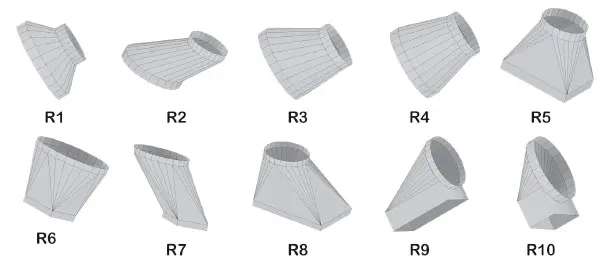
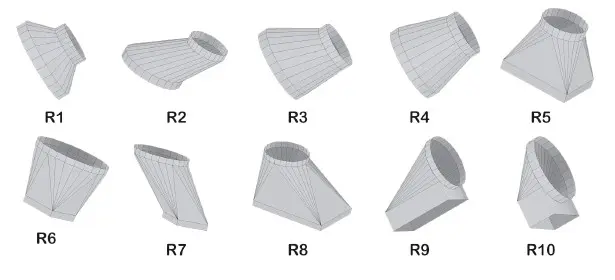
Transitions
توضیحات
The spiral duct transition is one of the most widely used fittings in HVAC systems, utilized for changing the duct diameter and adapting the airflow path. This connection plays an important role in maintaining pressure balance, reducing air turbulence, and increasing the overall efficiency of the system, and is widely used in various air conditioning projects, from residential buildings to industrial spaces.
توضیحات تکمیلی
Introduction to Transitions in Spiral Duct Systems
In many ventilation projects, it is necessary to change the duct diameter along the path; this change may be due to a decrease or increase in air flow rate, space limitations, or connecting the main duct to sub-branches. The spiral duct transition is designed exactly to meet this need and provides the possibility of changing the duct size in a principled and standard manner.
Using the appropriate transition prevents sudden pressure drops and noise generation in the system and guides the airflow uniformly.
Applications of Spiral Duct Transitions
Transitions are used in various parts of the ventilation system, including:
- Changing the main duct diameter
- Connecting ducts of different sizes
- Decreasing or increasing air flow rate along the path
- Principled branching from main ducts
- Adapting the ventilation system to architectural limitations
In professional projects, the correct use of transitions has a direct impact on fan performance and energy consumption.
Types of Spiral Duct Transitions
Spiral duct transitions are divided into several main categories based on shape and application:
Concentric Transition
In this type of transition, the inlet and outlet duct axes are aligned.
Advantages:
- Uniform distribution of airflow
- Lower pressure drop
- Suitable for straight paths
Eccentric Transition (Offset)
In an eccentric transition, the inlet and outlet duct axes are not aligned.
Applications:
- Use in confined spaces
- Passing building obstacles
- Coordination with ceiling or floor
The choice of transition type depends on project conditions and system design.
Impact of Transition Design on Airflow
The principled design of a spiral duct transition plays a very important role in reducing flow turbulence. Transitions made with a gentle slope and appropriate length:
- Prevent air vortex formation
- Reduce system pressure drop
- Minimize system-generated noise
- Increase the useful lifespan of ventilation equipment
Non-standard or short transitions can cause serious disruption to system performance.
Material and Composition of Spiral Duct Transitions
Spiral duct transitions are usually manufactured from the following materials:
- Galvanized steel sheet (most common option)
- Stainless steel sheet (for special environments)
- Aluminum sheet (lightweight and resistant)
Galvanized sheet is the primary choice in most construction and industrial projects due to its corrosion resistance, high strength, and suitable price.
Advantages of Using Standard Spiral Transitions
Using standard transitions in the spiral duct system offers numerous benefits:
- Maintaining ventilation system efficiency
- Reducing fan energy consumption
- Preventing air leakage
- Fast and easy installation
- Complete compatibility with other spiral fittings
- Increasing the overall lifespan of the system
These benefits create significant economic impact, especially in large projects.
Important Considerations in Choosing a Spiral Duct Transition
To choose the appropriate transition, attention must be paid to the following:
- Inlet and outlet duct diameters
- Type of transition (concentric or eccentric)
- Length and angle of size change
- Installation space
- Project usage type
- Manufacturing quality and sealing
Specialized consultation at this stage can prevent rework and increased costs.
Application of Spiral Duct Transitions in Different Projects
Transitions are used in various types of ventilation projects, including:
- Residential buildings
- Office and commercial complexes
- Hospitals and medical centers
- Factories and industrial spaces
- Sports halls and warehouses
In each of these projects, the correct choice of transition plays an important role in the optimal performance of the ventilation system.
Conclusion
The spiral duct transition is one of the key components of HVAC systems that enables the principled change of duct diameter. Using standard and high-quality transitions reduces pressure drop, improves airflow, and increases system productivity. Kian Fan professionally meets the needs of different ventilation projects by offering various types of spiral duct transitions in accordance with modern standards.